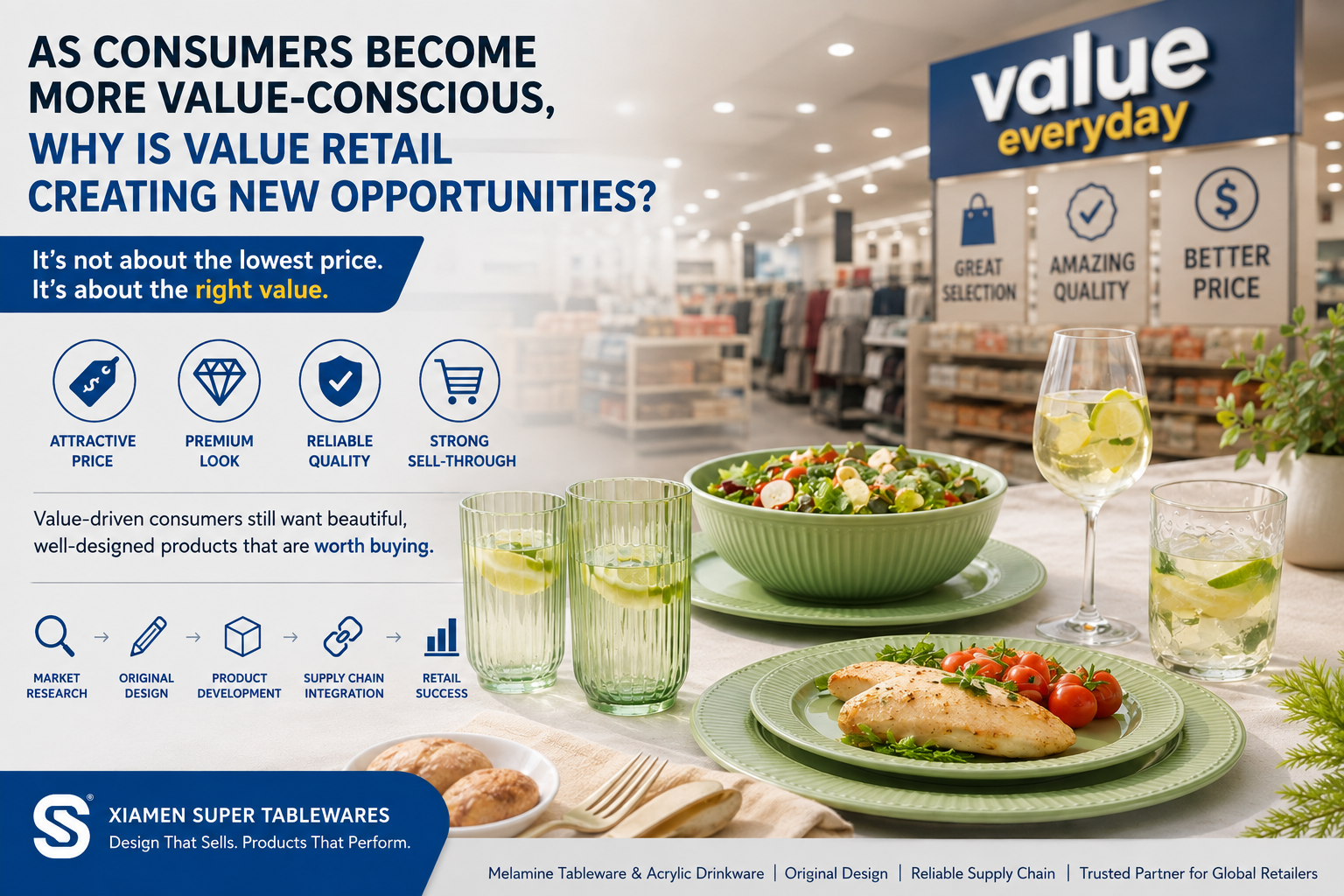
As Consumers Become More Value-Conscious, Why Is Value Retail Creating New Opportunities?
The global consumer market is going through an interesting shift.
On one hand, economic uncertainty is making consumers more cautious and increasingly price-conscious.
On the other hand, value retailers such as TJX, Ross, and Burlington continue to grow and expand their store networks.
Why?
We believe this reflects something deeper than consumers simply “spending less.”
Consumers are becoming more selective about what is truly worth buying.
They still want beautiful tableware. They still want stylish products for their homes, outdoor gatherings, and everyday lives. And they are still willing to pay for good design and reliable quality.
But increasingly, they are asking one simple question:
Is it worth the price?
That may be one of the most important shifts shaping retail in the years ahead.
Value Retail Is About More Than Low Prices
Price matters. But from a product development perspective, low price and good value are not the same thing.
A low-cost product without strong design, reliable quality, or meaningful differentiation may not necessarily deliver strong sales.
A truly competitive product should create a different reaction.
When consumers first see it, they should think:
“This looks more expensive than it is.”
And when they see the price:
“That’s worth buying.”
That is how we think about value for money.
It is not simply about lowering prices. It is about maximizing what consumers receive within a price point they are comfortable with:
Design Value + Perceived Value + Quality + Functionality
As consumers become more rational and selective, we believe this capability will become increasingly important.
For Retailers, Sell-Through Matters More Than Purchase Price Alone
For a retail buyer or category manager, purchase price will always matter.
But it is only one part of the equation.
A product may have an attractive sourcing cost, but if it moves slowly after reaching the shelf, requires repeated markdowns, or creates excess inventory, the initial cost saving may ultimately create very little value.
That is why, when developing products, we increasingly ask questions such as:
Why would a consumer pick this product up from the shelf?
What makes it different from the product next to it?
Does it reflect current color, pattern, and lifestyle trends?
Is the retail price compelling enough?
How many SKUs should be included in the collection?
Which products should become the hero items?
Which items create visual impact, and which ones are likely to drive volume?
Ultimately, all of these questions lead to one:
Will consumers buy it?
This is why, at Xiamen Super Tablewares, we believe product development should not begin with a factory or even with a design.
It should begin with the market.
Start With the Market, Not the Factory
Every year, we continuously study overseas retail markets.
We look at what chain retailers, supermarkets, value retailers, and home & living stores are selling. We study consumer preferences, competitive assortments, retail price points, colors, patterns, and emerging lifestyle trends.
Our management and product development teams also conduct regular overseas market visits.
Because there are things that a trend report alone cannot tell you.
When you walk through a store, you can see:
Which products receive the strongest merchandising positions.
Which colors are appearing across multiple categories.
Which price points dominate the assortment.
Which collections retailers are actively promoting.
And, most importantly, what consumers are actually putting into their shopping carts.
Those observations eventually come back into our product development process.
We do not follow trends simply to be trendy. We want to translate trends into products that sell.
Premium Look Does Not Have to Mean Premium Price
This has long been one of our key product development principles for melamine tableware and acrylic drinkware.
Our goal is neither to make the most expensive product in the market nor simply the cheapest.
We want to find the most competitive position between the two:
Premium Look. Affordable Price. Reliable Quality.
We want consumers to enjoy products with strong design and perceived quality at prices that still feel accessible.
Since 2018, we have continuously invested in original artwork development.
Every year, we collaborate with more than 100 independent artists in Xiamen, acquiring exclusive hand-painted artwork and continuously expanding our original design library.
But owning great artwork is only the beginning.
Successful product development requires another layer of thinking:
Which design + which product + which color + which price + which packaging + which retail channel?
Only when these elements work together can an attractive design become a commercially competitive collection.
Because we believe:
Design is not just decoration. Design should create commercial value.
Good design should help retailers differentiate their assortments, attract attention at shelf, and ultimately convert that attention into sales.
Retail Competition Is Also Becoming a Supply Chain Efficiency Competition
We are seeing another important change in the market.
Many retail customers no longer want to manage a large number of fragmented suppliers.
They increasingly value partners who can help them accomplish more.
For categories such as melamine tableware and acrylic drinkware, a successful retail program is rarely about one individual item. It is usually about building a complete and commercially balanced collection.
That is why, in addition to developing our own products, we continue to integrate relevant supply chain resources.
From plates, bowls, and serving pieces to trays, pitchers, tumblers, and related products, our goal is to help customers build more complete assortments around their retail channels, target consumers, and price positioning.
Our role has therefore evolved beyond manufacturing into a more integrated process:
Market Research → Collection Planning → Original Design → Product Development → SKU Assortment → Packaging → Merchandising → Supply Chain Integration → Launch Support
The purpose is not to make sourcing more complicated.
It is to make product development and procurement simpler, faster, and more effective for our customers.
The Best Suppliers of the Future Will Help Reduce the Cost of Decision-Making
The traditional sourcing model often looks like this:
Customer provides a product → Factory quotes → Sampling → Production.
But in today's fast-changing retail environment, we believe suppliers can create much more value.
If we can study the market before development begins;
if we can identify relevant trends;
if we can provide original designs;
if we can help structure the right SKU assortment;
if we can integrate the right supply chain resources;
and if we can consider price architecture and inventory risk earlier in the process;
then the value we create is no longer limited to saving a few cents on the purchase price.
We can also help reduce:
Product Development Cost, Decision-Making Cost, Time-to-Market, and Inventory Risk.
For large retail organizations, these factors can be far more important than a few cents of difference in unit cost.
Consumers Have Not Stopped Wanting a Better Life
They are simply becoming more rational about how they spend.
Consumers still want a beautiful table.
They still want family gatherings to feel special.
They still want outdoor dining to be easier and more enjoyable.
And they still want good products to make everyday life a little better.
They simply expect to get more for what they spend.
That is why we do not see value retail purely as a short-term response to economic uncertainty.
It represents a broader shift in how consumers evaluate the relationship between price, design, quality, and value.
And that shift will continue to influence the entire retail supply chain.
The most competitive product of the future may not be the cheapest one.
It will be the product that makes a consumer stop at the shelf, notice the design, experience the quality, look at the price, and think:
“This is worth buying.”
That is what we continue to work toward at Xiamen Super Tablewares.
We are not trying to make the cheapest products in the market.
We want to create products consumers feel are worth buying — and products retailers can sell with confidence.
Design That Sells. Products That Perform.