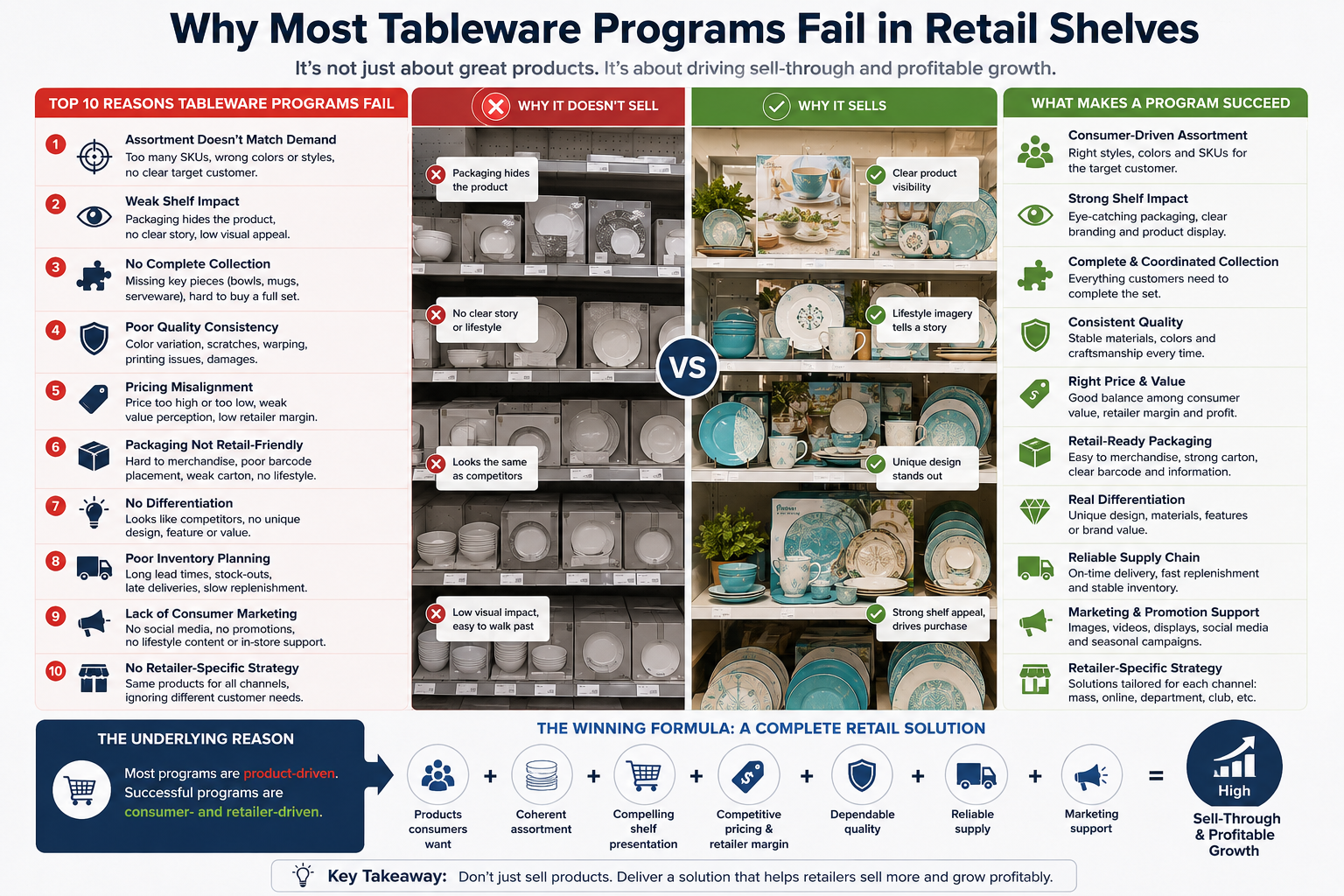
Why Most Tableware Programs Fail in Retail Shelves
Most tableware programs don't fail because the products are poor—they fail because they don't sell through once they reach the shelf. Retailers care about sell-through, not just attractive designs or low purchase prices.
Here's a practical breakdown.
1. The assortment doesn't match consumer demand
Many suppliers focus on what looks good at trade shows rather than what consumers actually buy.
Common problems:
Too many SKUs that confuse shoppers.
Colors or patterns that don't fit current home trends.
Designs that are either too plain or too niche.
No clear target customer (family, premium, outdoor, seasonal, etc.).
Result: Low conversion and slow inventory turnover.
2. Weak shelf impact
A customer often decides within a few seconds.
Programs fail when:
Packaging hides the product.
Colors don't stand out.
The display lacks a clear story.
Price doesn't match the perceived value.
Successful programs answer immediately:
3. No complete collection
Consumers increasingly buy coordinated sets.
If the program offers only dinner plates, for example, but not:
bowls,
serving pieces,
mugs,
trays,
matching accessories,
customers may purchase elsewhere where they can complete the collection.
4. Poor quality consistency
Retailers can tolerate occasional defects, but recurring issues damage consumer trust.
Examples include:
Returns quickly erode retailer confidence.
5. Pricing isn't aligned with the market
Being the cheapest isn't enough.
Failure occurs when:
retail price exceeds consumer expectations,
margins are too thin for retailers,
promotional pricing isn't supported,
competitors offer stronger value at similar prices.
A successful program balances:
consumer value,
retailer margin,
supplier profitability.
6. Packaging isn't retail-friendly
Retail packaging should do more than protect the product.
Common mistakes:
Packaging is often the first "salesperson."
7. No differentiation
Many tableware products look almost identical.
If the only selling point is price, competitors can easily undercut it.
Strong differentiators include:
8. Poor inventory planning
Retailers dislike both stock-outs and excess inventory.
Programs fail because:
lead times are too long,
replenishment is unreliable,
seasonal products arrive late,
best sellers go out of stock while slow movers remain.
Reliable supply is often as important as product design.
9. Lack of consumer marketing
Even a great product needs demand generation.
Without:
social media support,
influencer content,
lifestyle photography,
in-store displays,
seasonal promotions,
products rely entirely on shelf traffic.
10. No retailer-specific strategy
Different retail channels have different priorities.
For example:
Mass retailers prioritize value, consistency, and supply reliability.
Department stores focus more on design and brand perception.
Club stores need strong value in larger pack sizes.
E-commerce requires excellent images, reviews, and packaging suitable for parcel shipping.
Using the same assortment and packaging for every channel often leads to disappointing results.
The underlying reason
Most unsuccessful tableware programs are product-driven, while successful ones are consumer- and retailer-driven. The winning formula isn't just a beautiful plate—it's a complete retail solution that combines:
products consumers want,
a coherent assortment,
compelling shelf presentation,
competitive pricing and retailer margins,
dependable quality,
reliable supply,
and marketing support that drives sell-through.
For suppliers of melamine or acrylic tableware, demonstrating how your collection improves a retailer's sales and inventory performance—not just showcasing attractive products—can be a much stronger selling proposition.